

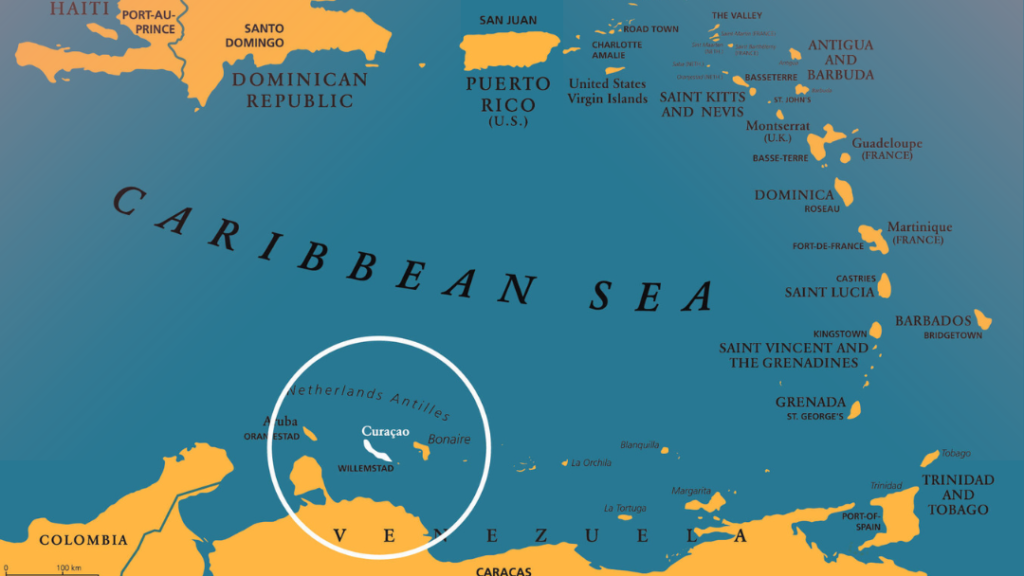
Curaçao is a Dutch Caribbean island and an autonomous country within the Kingdom of the Netherlands. Located about 37 miles (60 km) north of Venezuela in the southern Caribbean Sea, Curacao in South America lies on the northern edge of the South American continental shelf. Curacao, along with the ABC Islands and Trinidad and Tobago, sits on the South American continental shelf and so is geographically close to the continent.
But to be clear, it’s not considered a state of South America. Politically and culturally, it belongs to the Caribbean and the Dutch Kingdom.
Where Exactly is Curacao? (Geographic Location)
Curacao lies in the southern Caribbean Sea which is 40 miles (65 km) north of Venezuela. Specifically, this comes to approximately 12.1696° N latitude and 68.9900° W longitude, but slightly towards the north of the coast of South America.
The island, along with Aruba and Bonaire, is part of the Dutch Caribbean and is known as one of the ABC Islands.
A few geographic references to know context to its position:
Venezuela is roughly 40 miles (65 km) to the south and Colombia lies about 185 miles (300 km) to the southwest. Aruba is about 77 km west of Curacao, while Bonaire is located to the east.
Curacao is the biggest of the ABC Islands, with an area of 171 square miles (444 square kilometers) with an estimated population of approximately 156,700 people in 2025.
Is Curacao Part of South America? (The Core Question)
If looked at geologically, Curaçao is part of the continental shelf off the nearby mainland. This shelf is the submerged continuation of that landmass, which it shares with neighboring Venezuela and other islands in the region.
As a result, the island has a physical geographic link to the South American landmass. Despite its geographic link, Curacao is not politically or culturally a part of South America.
Brief History of Curacao
The island was first settled by Arawak and Caquetio Amerindian people, who had come from the mainland of South America centuries ago.
Then Europeans came in 1499, with Spanish explorers first visiting the island. In 1527, Spain later founded a settlement, yet the island could not stay under the control of Spain for long.
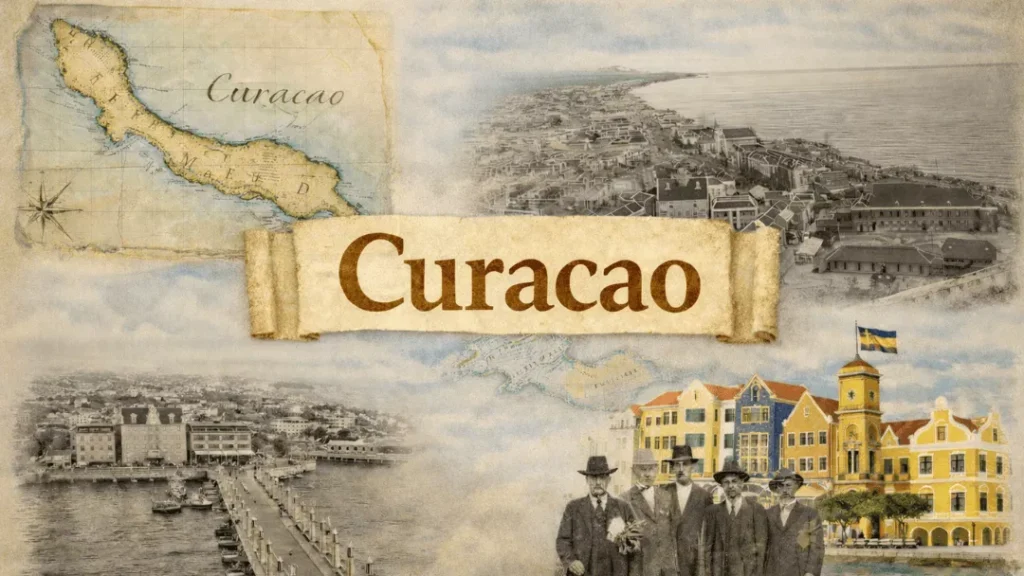
In 1634, the Dutch West India Company seized Curacao from Spain and made it a strategic trading post in the Caribbean. The island became a center of trade affairs between Europe, Africa and the Americas.
During this time, Sephardic Jews from Portugal and Spain settled on the island in the 1500s, what is today thought to be the oldest continuously inhabited Jewish community in the Western Hemisphere.
Despite many political changes across the Caribbean for centuries, Curacao remained under the Dutch since 1816, and its institutions, architecture and governance still reflect this.
Curacao vs. South America: From a Travel Standpoint
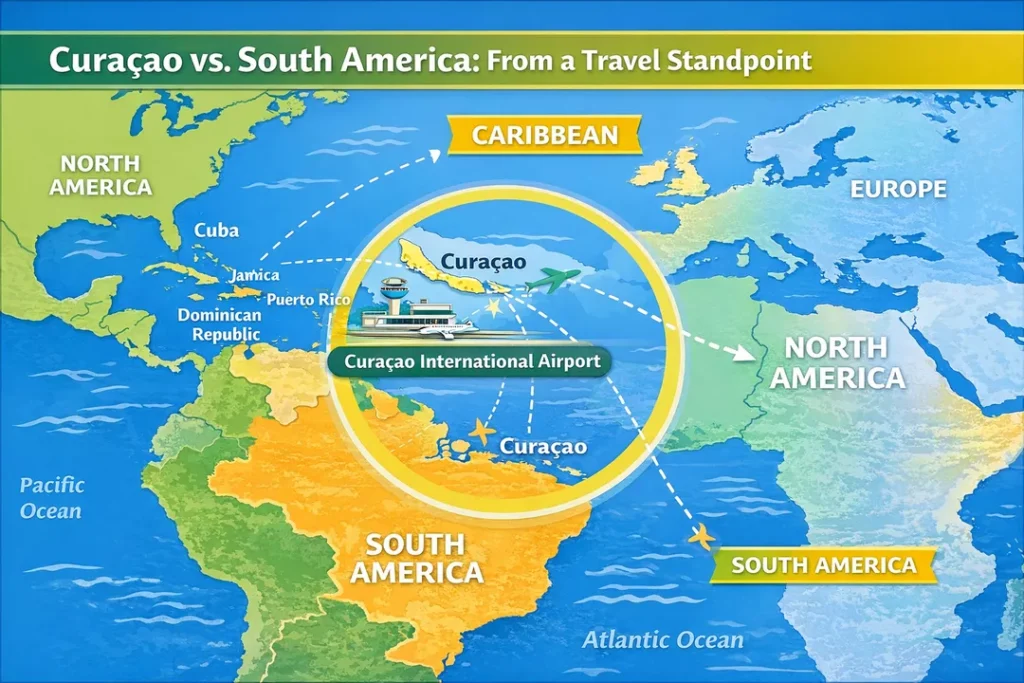
From a travel perspective, Curaçao is placed in a strategic spot between the Caribbean and the northern part of the mainland continent.
Curaçao International Airport connects travelers to destinations across the Caribbean, the Americas, and Europe.
Due to its geographical positioning, the island acts as a gateway between nearby regions. Moreover, Curaçao is typically regarded as a Caribbean travel destination rather than being associated with the mainland continent.
FAQs:
Yes, Curacao is generally considered a safe destination for travelers compared with many Caribbean and Latin American locations.
Yes, Curacao is officially a country, but it is not an independent nation.
Curacao is part of the Caribbean, not South America.
Conclusion
It makes sense that many people identify it with South America because it sits on the continental shelf of that region. However, politically and culturally the island is not considered part of the mainland. For travelers and geography enthusiasts alike, Curaçao represents a unique crossroads where Caribbean landscapes, European heritage, and its proximity to South America all come together in one place.
Find more travel inspiration and fascinating journeys at Fashioned Travel.
Continue Exploring: